India & international online classes · Mon–Fri, 9 AM–7 PM IST+91 93900 23585info@learnai.co.in
Learn. Practise. Apply.

Generative AI & Agentic AI
Course at LearnAI

Explore generative ai & agentic ai through a 33-module curriculum and 4 project topics. Build foundations in Python, NLP, machine learning and transformers, then explore LLM applications, prompts, retrieval-augmented generation, AI agents and multi-agent workflows. The curriculum includes memory, MCP, human approval, evaluation, guardrails and deployment.

Online India & worldwideClassroom Learn at a branchHybrid Online + classroom
Classroom: Dilsukhnagar, Hyderabad
Online: USA, Canada, UK, Australia, New Zealand and Germany

Ask about your preferred mode, branch and upcoming batch.

Illustration of AI collaboration and connected tools

Upcoming GenAI with Agentic AI batches

Contact LearnAI for the next batch. Ask on WhatsApp.

View all upcoming batches

33 modulesFoundations to applied learning
4 project topicsDomain practice and a capstone
3 training modesOnline · Classroom · Hybrid
Talk to LearnAIFees, duration and batch details
Understand the programme

Learn Generative AI & Agentic AI through practical study.

Build foundations in Python, NLP, machine learning and transformers, then explore LLM applications, prompts, retrieval-augmented generation, AI agents and multi-agent workflows. The curriculum includes memory, MCP, human approval, evaluation, guardrails and deployment.

Your willingness to learn comes first

Who can join?

Build new skills or upgrade your technology knowledge. LearnAI welcomes students pursuing a degree, graduates, working professionals and learners from relevant domains.

Basic computer knowledge

Basic computer knowledge is recommended to help you participate in practical learning.

Students and professionals

Join while pursuing a degree, after graduation, or to develop skills for your relevant domain.

No prior technology knowledge required

You can begin without previous knowledge of the course technology. Bring your interest and willingness to learn.

No age limit

Learners of all ages are welcome. Learners under 18 should enrol with a parent or guardian’s consent.

What the curriculum develops

Skills you will practise.

Develop Python and AI foundations

Study data preparation, NLP, machine learning and transformers.

Build LLM applications

Connect prompts, APIs, structured outputs and user interfaces.

Retrieve useful knowledge

Explore embeddings, vector databases, hybrid search and RAG.

Develop tool-using agents

Study function calling, memory, state and MCP.

Design agentic workflows

Explore multi-agent patterns, human approval and recovery.

Evaluate and deploy systems

Study guardrails, tracing, cost, latency and LLMOps.

The complete learning path

Generative AI & Agentic AI course curriculum.

Explore all 33 modules. Open a module to view its topics, and discuss the delivery plan for your batch.

01 / Python and AI foundations

MODULE 01Python Fundamentals
  • Python Introduction
  • Variables & Data Types
  • Conditions & Loops
  • Functions & Collections
  • File Handling
  • Exceptions & OOP
  • Modules & Packages
  • Virtual Environments
MODULE 02Python Libraries for AI
  • NumPy Arrays
  • Pandas DataFrames
  • Data Manipulation
  • Matplotlib Plots
  • Seaborn Basics
  • CSV / Excel / JSON
  • API Requests
  • Git & GitHub Basics
MODULE 03Statistics for AI
  • Descriptive Statistics
  • Probability Basics
  • Distributions
  • Variance & Deviation
  • Sampling
  • Correlation
  • Outliers
  • Scaling Concepts
MODULE 04Numerical Data Prep
  • Data Investigation
  • Missing Values
  • Duplicate Handling
  • Outlier Analysis
  • Cleaning & Wrangling
  • Transformation
  • Feature Engineering
  • Preprocessing
MODULE 05Text Data & NLP
  • Text Investigation
  • Text Cleaning
  • Normalization
  • Tokenization
  • Stop Words
  • Stemming / Lemmas
  • TF-IDF & N-grams
  • Sentence Embeddings
MODULE 06Machine Learning
  • ML Workflow
  • Supervised Learning
  • Unsupervised Learning
  • Regression
  • Classification
  • Clustering
  • Train / Test Split
  • Model Evaluation
MODULE 07Deep Learning
  • Neural Networks
  • Neurons & Layers
  • Activation & Loss
  • Forward Propagation
  • Backpropagation
  • Optimizers
  • Embeddings
  • CNN / RNN / LSTM
MODULE 08Transformers
  • Tokens & Embeddings
  • Positional Encoding
  • Self-Attention
  • Query / Key / Value
  • Multi-Head Attention
  • Feed-Forward Layers
  • Encoder & Decoder
  • BERT vs GPT

02 / Generative AI and LLM systems

MODULE 09GenAI Fundamentals
  • Traditional AI vs GenAI
  • Foundation Models
  • Text Generation
  • Image & Audio Generation
  • Video & Multimodal AI
  • Use Cases & Limitations
  • Hallucinations
  • Responsible Use
MODULE 10Large Language Models
  • LLM Architecture
  • Tokens & Context Window
  • Pretraining
  • Instruction Tuning
  • Fine-Tuning Concepts
  • Inference Settings
  • Temperature & Top-p
  • Open vs Proprietary
MODULE 11LLM Models & Platforms
  • OpenAI
  • Anthropic Claude
  • Google Gemini
  • NVIDIA Models
  • Hugging Face
  • Ollama & Local LLMs
  • Model Selection
  • Provider Limitations
MODULE 12Prompt Engineering
  • System / User Instructions
  • Zero-shot & Few-shot
  • Role & Context Prompting
  • Prompt Templates
  • Prompt Chaining
  • Structured Prompting
  • JSON Outputs
  • Prompt Evaluation
  • Injection Awareness
MODULE 13LLM APIs & Integration
  • API / REST Fundamentals
  • HTTP & JSON
  • API Keys & .env
  • Provider SDKs
  • Model Parameters
  • Streaming Outputs
  • Errors & Retries
  • Rate Limits
  • Usage & Costs
MODULE 14AI App Development
  • Python LLM Integration
  • FastAPI Endpoints
  • Request / Response
  • Input Validation
  • Structured Outputs
  • UI Integration
  • Session Handling
  • Logging & Testing
  • Deployable Application

03 / Retrieval-augmented generation

MODULE 15Embeddings & Vector Databases
  • Word / Sentence Embeddings
  • Semantic Similarity
  • Cosine Similarity
  • Vector Search
  • Indexing & Metadata
  • ChromaDB / FAISS
  • Vector Store Updates
  • Embedding Evaluation
MODULE 16RAG Fundamentals
  • Why RAG?
  • RAG Architecture
  • Knowledge Base
  • Document Loading
  • Parsing & Chunking
  • Embedding Pipeline
  • Retrieve / Generate
  • Grounded Answers & Sources
MODULE 17Retrieval Techniques
  • Keyword & Full-text
  • Sparse / Dense Search
  • Semantic Search
  • Metadata Filtering
  • Hybrid Search
  • Similarity / MMR
  • Multi-Query Retrieval
  • Reranking
MODULE 18Advanced RAG & Agentic RAG
  • Chunking Strategies
  • Query Expansion & Rewriting
  • Parent-child Retrieval
  • Conversational RAG
  • Hybrid Search + Reranker
  • Multimodal RAG Concepts
  • Corrective & Agentic RAG
  • RAG Evaluation & Guardrails
MODULE 19Real-World RAG Project
  • Enterprise Knowledge Assistant
  • PDF / Document Ingestion
  • Chunking & Vector Index
  • Hybrid Retrieval + Reranking
  • LLM Answer + Citations
  • Conversation-aware Interface
  • Evaluation & Safe Fallback
  • Deployment

04 / AI agents and tool integration

MODULE 20AI Agent Fundamentals
  • Agent vs Chatbot / RAG
  • Goals & Instructions
  • Model + Tools
  • Reasoning / Planning
  • Action / Observation
  • Agent Decision Loop
  • ReAct Concepts
  • Agent Limitations
MODULE 21Tools & Function Calling
  • Tools vs Functions
  • Python Functions as Tools
  • API / Database Tools
  • Search & File Tools
  • Typed Arguments
  • Tool Result Handling
  • Retries & Errors
  • Permissions & Approvals
MODULE 22Agent Memory & State
  • Conversation Memory
  • Session / Working Memory
  • Short-term Memory
  • Long-term Memory
  • Vector-based Memory
  • State Management
  • Persistent Checkpoints
  • Memory Quality / Privacy
MODULE 23Model Context Protocol
  • MCP Introduction
  • Host / Client / Server
  • Tools & Resources
  • Prompts
  • Connecting Data Sources
  • Building MCP Servers
  • Agent MCP Integration
  • Secure Access Basics
MODULE 24Agent Frameworks
  • Framework-free Agent
  • LangChain Fundamentals
  • Tool Integration
  • LangGraph Nodes / Edges
  • Shared Graph State
  • Conditional Routing
  • Checkpoints & Retries
  • Traceable Workflows
MODULE 25AI Agent Project
  • Customer Support Agent
  • Knowledge-base RAG
  • Custom API Tools
  • Database Retrieval
  • Ticket Creation
  • Session Memory
  • Guardrails
  • Human Escalation
  • User Interface

05 / Agentic AI and multi-agent systems

MODULE 26Agentic AI Fundamentals
  • Agent vs Agentic System
  • Goals & Autonomy
  • Reasoning / Planning
  • Action / Feedback
  • Reflection
  • Replanning
  • Success Criteria
  • State & Control
MODULE 27Workflow Patterns
  • Sequential & Parallel
  • Routing / Conditions
  • Supervisor / Worker
  • Planner / Executor
  • Reviewer Pattern
  • Reflection Loop
  • Evaluator / Optimizer
  • Retries / Recovery
MODULE 28Multi-Agent Systems
  • Agent Roles
  • Specialized Agents
  • Task Delegation
  • Agent Communication
  • Shared Memory / State
  • Agent Handoffs
  • Supervisor Orchestration
  • Conflict Handling
MODULE 29Human Approval & HITL
  • Approval Gates
  • Manual Reviews
  • Sensitive Operations
  • Interrupt / Resume
  • Checkpoints
  • Escalation Rules
  • Human Feedback
  • Audit Trail
MODULE 30Guardrails & Security
  • Input / Output Checks
  • Tool Permissions
  • Prompt Injection
  • PII Protection
  • Privacy Basics
  • Safe Failure
  • Access Control
  • Human Escalation
MODULE 31Evaluation & Tracing
  • LLM Output Evals
  • RAG Quality Evals
  • Agent Task Completion
  • Tool Choice & Accuracy
  • Agent Trajectories
  • Faithfulness / Relevance
  • Cost & Latency
  • Logs and Traces
MODULE 32Deployment & LLMOps
  • FastAPI & UI
  • Docker Basics
  • Secrets & Auth
  • Deploying Endpoints
  • Monitoring
  • Token / Cost Tracking
  • Error Handling
  • Versioning / Tests
MODULE 33Agentic Capstone
  • Autonomous Platform
  • Supervisor + Workers
  • RAG + Tools
  • MCP Connections
  • Agent Shared State
  • Human Approval
  • Quality Evaluation
  • Deployment Demo
Explore the concepts visually

A visual look at the subject

Illustrative overviews. Refer to the curriculum for the topics included in your course.
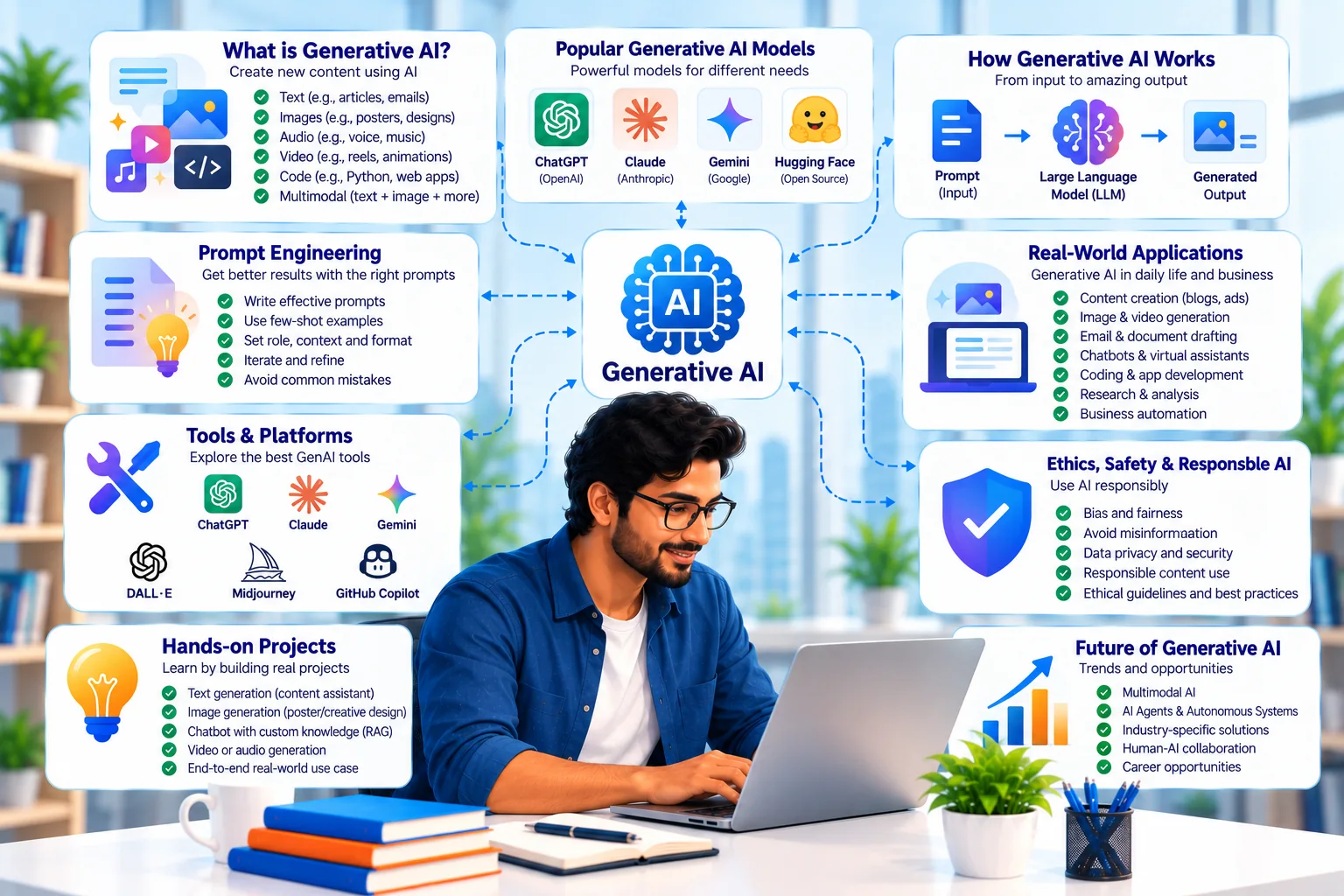
Generative AI overview illustration
Generative AI overview · Open image to enlarge
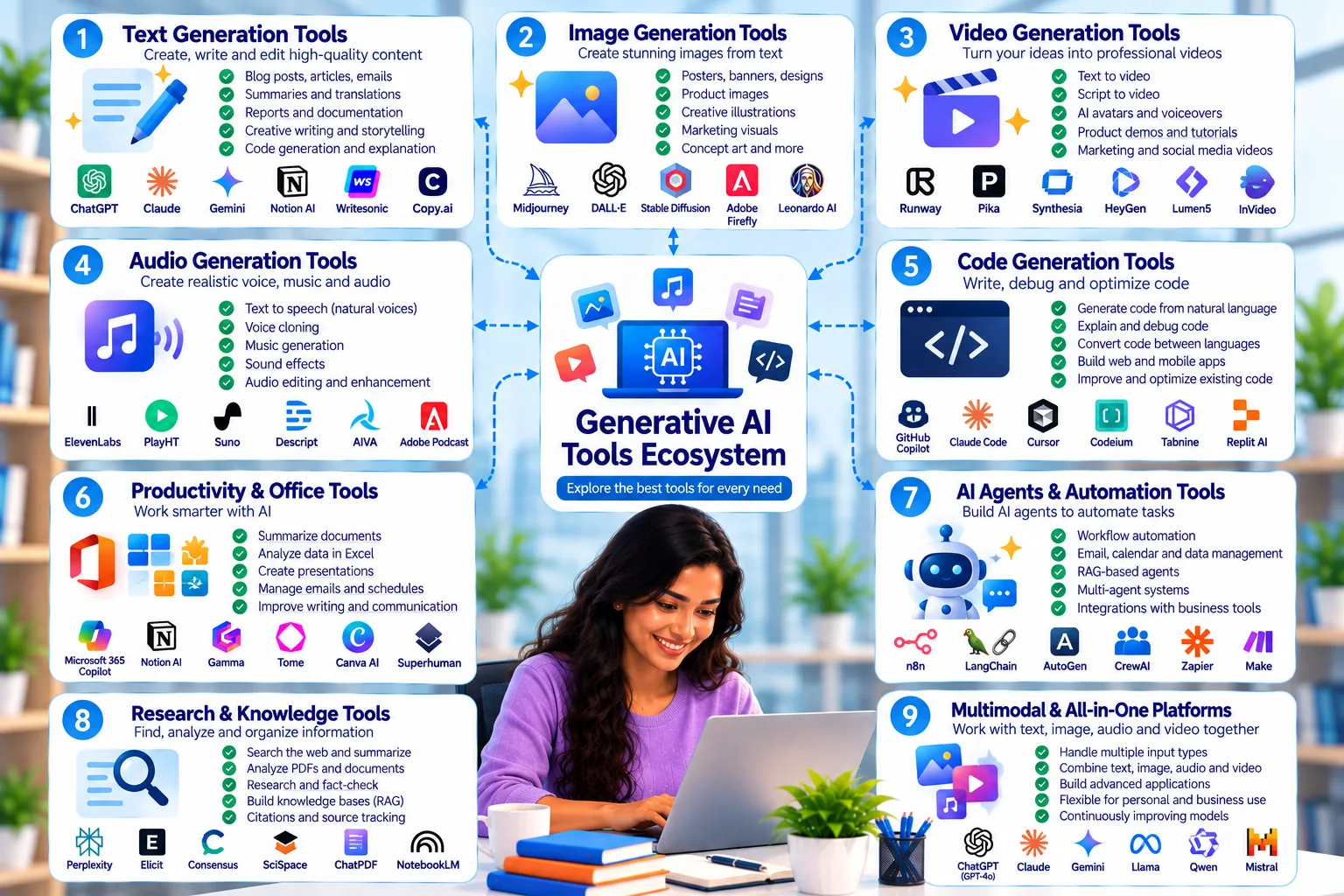
Generative AI tools illustration
Generative AI tools · Open image to enlarge
Your technical toolkit

Tools and technologies in the curriculum.

PythonOpenAIClaudeGeminiOllamaChromaFAISSLangChainLangGraphMCPFastAPIDockerHugging FaceGit & GitHub
Apply the learning

4 Generative AI & Agentic AI project topics.

Ask about the learning datasets, project selection, guidance and delivery for your batch.

GenAI Application

Connect prompts, LLM APIs and structured outputs.

Enterprise RAG

Combine documents, embeddings, hybrid retrieval and citations.

AI Agent Project

Build a customer support agent using RAG and API tools.

Agentic AI Capstone

Connect supervisor and worker agents, MCP, human approval and evaluation.

Choose how you learn

Generative AI & Agentic AI training near you and online.

Online training

Join from India, the USA, Canada, UK, Australia, New Zealand and Germany. Confirm your batch and time-zone schedule.

Classroom training

LearnAI Classroom: Dilsukhnagar, Hyderabad. Confirm this course, batch and exact address before visiting.

Hybrid training

Discuss combined online and classroom participation at your preferred branch. Confirm the delivery arrangements for your batch.

Fees, duration, prerequisites and upcoming batches are available on enquiry.

Learn with professional guidance

Experienced trainers. Practical knowledge.

Working professionalsIndustry knowledge connected to practical learning
10+ yearsRelevant professional experience within our core trainer team
Experienced trainersGuidance for concepts, tasks and project work

LearnAI’s core trainer team is supported by additional and part-time trainers. Trainer assignments and relevant experience vary by course, branch, training mode and batch availability. Experience figures refer to professional experience, not years of teaching.

For your batch’s trainer details, contact LearnAI.
Plan your next step

Career directions and learning support.

Roles to explore

Career directions listed in the brochure. Entry requirements depend on the role, employer and your background.

Generative AI DeveloperLLM EngineerRAG EngineerAI Agent DeveloperAgentic AI EngineerAI Application DeveloperAI Automation EngineerAI Solutions Engineer

Discuss career assistance

Ask about resume preparation, ATS compatibility, job-description matching, cover letters, interview practice, job discovery and application support. Confirm current availability and what is included with your enrolment.

Enrolled students receive access details for their applicable LearnAI learning and career assistance applications.

Ask About Career Assistance ↗
Before you enrol

Generative AI & Agentic AI course questions.

Review the curriculum and ask for current delivery and enrolment details.

What does the LearnAI Generative AI & Agentic AI Course cover?

The curriculum has 33 modules. Build foundations in Python, NLP, machine learning and transformers, then explore LLM applications, prompts, retrieval-augmented generation, AI agents and multi-agent workflows. The curriculum includes memory, MCP, human approval, evaluation, guardrails and deployment.

Which tools and technologies are included?

The curriculum lists Python, OpenAI, Claude, Gemini, Ollama, Chroma, FAISS, LangChain, LangGraph, MCP, FastAPI, Docker, Hugging Face, Git & GitHub. Ask LearnAI about software setup and any tool accounts required for your batch.

Which projects are listed?

Project topics include GenAI Application, Enterprise RAG, AI Agent Project, Agentic AI Capstone. Confirm datasets, guidance and project selection with LearnAI.

Does the course include RAG, MCP and multi-agent systems?

Yes. The five phases include RAG, agent tools and memory, Model Context Protocol, multi-agent workflows, human approval, guardrails, evaluation and LLMOps. The curriculum also includes project modules.

Can I join online from outside India?

Yes. LearnAI offers online classes for learners in India and abroad, including the USA, Canada, UK, Australia, New Zealand and Germany. Ask about Generative AI & Agentic AI batch availability and your time-zone schedule.

Where can I attend classroom or hybrid training?

LearnAI is in Dilsukhnagar, Hyderabad. Confirm Generative AI & Agentic AI availability, delivery mode and the exact address before visiting.

What are the fees, duration and prerequisites?

Contact LearnAI on WhatsApp at +91 93900 23585 for current fees, duration, prerequisites and batch details. Share your background and preferred training mode.

What career assistance can I ask about?

Discuss resume support, job-description matching, interview practice, job discovery and application assistance. Confirm current availability and enrolment terms with LearnAI.

Discuss your learning goals

Ready to explore Generative AI & Agentic AI?

Share your background, preferred training mode, branch or country, and time zone.

Mon–Fri · 9 AM–7 PM IST · +91 93900 23585 · info@learnai.co.in

Chat with LearnAI ↗

What your course includes

Course charges cover

  • Live classes with a trainer
  • Doubt sessions
  • Assignments
  • Exams
  • Recordings
  • Portal access
  • Project assignment
  • Project explanation

Complimentary services

  • Resume writing
  • Mock interviews
  • Interview preparation
  • 100% job assistance

Job assistance does not guarantee a job offer.

Learner experiences

Google reviews by students

Feedback related to this programme · Editorial summaries, with original Google sources.

★★★★★

Sai keerthika

Review summary: Values helpful mentors and support for personal projects during GenAI training.

Read on Google
★★★★★

ammu12 kaneti

Review summary: Values practical Generative AI explanations, project work and internship experience.

Read on Google
WhatsApp ↗